
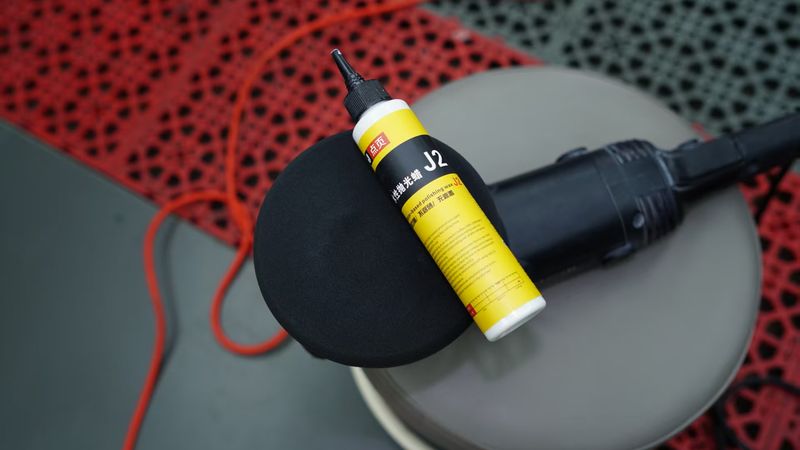
In auto detailing, polishing compounds and abrasive compounds are the two most commonly used product categories. However, due to similar names and overlapping functions, many beginners — and even professionals — struggle to distinguish between them. Using the wrong product not only fails to achieve expected results but may also damage the paint. This article compares polishing compounds and abrasive compounds from multiple dimensions including ingredients, principles, and applicable scenarios.
I. Basic Concepts & Definitions
1.1 Polishing Compound Definition
A polishing compound is a polishing material with a wax-based carrier, mixed with abrasives and other additives. The “wax” in its name refers to both its physical form and the fact that it contains real wax components.
Key characteristics:
- Base carrier: Typically contains carnauba wax, Brazilian carnauba, or other natural/synthetic waxes
- Abrasive particles: Contains alumina, silica, and other abrasives
- Function: Combines cutting, filling, and gloss enhancement
- Ease of use: Relatively simple operation, high tolerance for error
Polishing compounds are divided into light-cut, medium-cut, and heavy-cut grades based on cutting level. DianYe J2 Water-Based Polishing Wax is a medium-cut grade, suitable for common scratches and oxidation.
1.2 Abrasive Compound Definition
An abrasive compound is a precision abrasive material with an oil or chemical solvent base and high-concentration abrasive particles as the core ingredient.
Key characteristics:
- Base carrier: Typically oils, petroleum jelly, or dedicated chemical solvents
- Abrasive particles: High concentration, precise particle size distribution
- Function: Focused on cutting, pursuing ultimate grinding efficiency
- Ease of use: Professional-oriented, requires technique
Abrasive compounds are classified by grit grade, from coarse to fine, for different grinding stages.
1.3 Fundamental Differences
Simply put:
- Polishing compounds: Wax-based carrier, emphasizes combined results (cutting + protection)
- Abrasive compounds: Abrasive-focused, emphasizes professional cutting capability
Polishing compounds are “multi-purpose products”; abrasive compounds are “professional tools.”
II. Ingredient Comparison
2.1 Polishing Compound Ingredients
2.1.1 Base Waxes
Natural waxes: Carnauba wax (from Brazilian palm leaves), beeswax (good film-forming), paraffin (petroleum-derived, lower cost)
Synthetic waxes: Polyethylene wax (stable, durable gloss), fluoropolymers (hydrophobic, excellent protection)
Wax functions: Provide base gloss and lubrication; form protective film; help fill minor imperfections; enable even compound distribution.
2.1.2 Abrasive Particles
Alumina (Al₂O₃): Most common abrasive; high hardness; broad grit range.
Silica (SiO₂): Relatively mild abrasive; for fine polishing; gentler on sensitive paint.
Cerium Oxide (CeO₂): For glass polishing; not suitable for regular car paint.
Particle sizes: Coarse 1000-2000 mesh (20-15μm); Medium 2000-4000 mesh (15-6μm); Fine 4000-8000 mesh (6-2μm); Ultra-fine above 8000 mesh (<2μm).
2.1.3 Additives
Silicone oil (lubricity), solvents (mixing and evaporation), pigments/dyes (some products add to conceal scratches), thickeners (texture adjustment).
2.2 Abrasive Compound Ingredients
2.2.1 Base Carriers
Oils: Petroleum jelly (traditional base), mineral oil (stable), vegetable oil (eco-friendly but less stable).
Chemical solvents: Alcohol solvents (fast evaporation), ester solvents (good lubricity), dedicated solvents (optimized for specific abrasives).
Carrier functions: Carry high-concentration abrasives; provide necessary lubrication; enable even particle distribution; control heat during grinding.
2.2.2 Abrasive Particles
Abrasive compounds feature:
- High concentration: Typically 30-60% abrasive content vs. 5-20% in polishing compounds
- Precise grit: Narrow distribution; good batch consistency; clear grading (coarse/medium/fine/ultra-fine)
- Varied materials: Silicon carbide (SiC, extremely hard, for rough machining), alumina (Al₂O₃, versatile), diamond powder (finest grade)
2.3 Ingredient Comparison Table
| Category | Polishing Compound | Abrasive Compound |
|---|---|---|
| Base carrier | Wax-based (30-50%) | Oil/solvent-based (40-60%) |
| Abrasive particles | 5-20% | 30-60% |
| Particle size range | Wide range | Precisely graded |
| Additives | Gloss-enhancing, protective | Dispersing, lubricating |
| Wax content | Significant | Minimal or none |
III. Cutting Power Comparison
3.1 Cutting Power Levels
Level 1 — Ultimate Finishing: Extremely low cutting; removes faintest swirl marks, enhances gloss; above 8000 mesh; J5 Mirror Glaze Restorer belongs here.
Level 2 — Light Cutting: Low cutting; removes light scratches, daily care; 4000-8000 mesh; J2 Water-Based Polishing Wax fits here.
Level 3 — Medium Cutting: Medium cutting; removes moderate scratches and oxidation; 2000-4000 mesh.
Level 4 — Heavy Cutting: High cutting; removes deep scratches and orange peel; 1000-2000 mesh.
3.2 Polishing Compound Range
Light polishing compounds: Cutting near finishing compounds; for new cars or light care.
Medium polishing compounds: Moderate cutting; J2 Water-Based Polishing Wax fits here; handles common scratches and oxidation.
Heavy polishing compounds: Higher cutting; for old car restoration; requires technique; typically needs finishing treatment afterward.
3.3 Abrasive Compound Range
Coarse abrasive compounds: Extreme cutting; for severe defects; requires subsequent multi-step treatment; professional use.
Medium abrasive compounds: High cutting; removes moderate scratches; requires finishing treatment.
Fine abrasive compounds: Medium cutting; precision grinding; prepares for final finishing.
Ultra-fine abrasive compounds: Low-medium cutting; precision surface treatment; near-mirror results.
3.4 Cutting Power Comparison Table
| Type | Cutting Level | Removal Ability | Skill Level | Best For |
|---|---|---|---|---|
| Light polishing compound | Level 1 | Minor defects | Low | New car care |
| Medium polishing compound (J2) | Level 2 | Common scratches | Medium | Daily care |
| Heavy polishing compound | Level 3-4 | Medium-deep scratches | Med-High | Old car restoration |
| Coarse abrasive compound | Level 4+ | Deep defects | High | Professional repair |
| Fine abrasive compound | Level 2-3 | Moderate defects | Med-High | Professional care |
| Ultra-fine abrasive compound | Level 1-2 | Fine treatment | Medium | Precision finishing |
IV. Applicable Scenario Comparison
4.1 Polishing Compound Scenarios
- New car protection: Light or medium compound; removes transport/storage minor imperfections; provides base protection and gloss; simple DIY operation
- Daily care: Medium compound every 3-6 months; removes light oxidation and wash marks; restores gloss
- Common scratch repair: Medium to heavy compound based on scratch depth; J2 handles most common scratches
- Old car restoration prep: Heavy compound based on condition; removes most oxidation; prepares for coating/film
4.2 Abrasive Compound Scenarios
- Deep scratch repair: Coarse or medium abrasive compounds; requires RO or high-power DA; professional technique; must finish afterward
- Orange peel and wave treatment: Medium-high cutting compounds; multiple progressive steps; requires professional judgment
- Industrial paint treatment: Select grit by paint hardness; requires precise parameter control; typically professional use
- Glass grinding: Dedicated glass abrasive compounds (cerium oxide or tin oxide based); not for regular car paint
4.3 Scenario Selection Guide
| Scenario | Recommended Product | Notes |
|---|---|---|
| New car light care | Light polishing compound | Simple, safe |
| Daily quarterly care | J2 Water-Based Polishing Wax | Balanced effect and convenience |
| Common scratch repair | Medium-heavy polishing compound | Choose by scratch depth |
| Deep scratch repair | Abrasive compound (coarse→medium→fine) | Professional operation |
| Final gloss enhancement | J5 Mirror Glaze Restorer | Precision finishing |
| Old car full restoration | Heavy polishing compound + abrasive compound | Multi-step comprehensive treatment |
V. Usage Sequence & Methods
5.1 Standard Polishing Process
Step 1: Assessment & Preparation
- Assess paint under good lighting
- Touch for smoothness; note problem areas
- Thoroughly wash and dry
- Mask rubber, plastic, chrome, and trim
Step 2: Rough Treatment (if needed)
Heavy polishing compound or abrasive compound (coarse/medium). Spread at low speed; increase to working RPM; check progress frequently; wipe clean to inspect.
Step 3: Medium Treatment
Medium polishing compound (J2). Fresh medium-soft pad; moderate RPM; remove rough treatment marks; check uniformity.
Step 4: Fine Finishing
Light compound or restorer (J5). Fresh soft/ultra-soft pad; low RPM or hand apply; light passes to restore gloss; wipe promptly.
Step 5: Final Check
Inspect in multiple lighting conditions; touch up missed spots; thorough microfiber wipe; record process and results.
5.2 Product Pairing Recommendations
Daily care: J2 Water-Based Polishing Wax alone; every 3-6 months.
Professional setup: Heavy polishing compound + J2 + J5; annually 1-2 times.
Deep repair: Abrasive compound (coarse→medium→fine) + J5; as needed.
VI. Common Mistakes & Prevention
6.1 Over-Relying on Strong Products
Don’t use heavy compounds for every issue. Start light and progress as needed. Record results and parameters. Prefer multiple light passes over one heavy pass.
6.2 Wrong Product Selection
Understand the treatment goal and paint condition. Choose product grade based on actual needs. Follow “light to heavy” principle.
6.3 Improper Application
Dosage: Too little = insufficient lubrication, heat, scratches. Too much = waste, poor cutting. Right amount = thin, even coat.
Temperature: Never work continuously too long. Check paint temperature regularly. Cool naturally; don’t use A/C blast.
Movement: Never dwell on one spot. Keep movement even with 50% overlap. Change pads between stages; never use dirty pads.
6.4 Skipping Follow-Up Steps
Every cutting step needs appropriate finishing afterward. Final finishing is essential for the best results. Always do a thorough final inspection.
VII. Technical Deep Dive
7.1 How Abrasive Particles Work
Microscopic cutting: particle contacts paint → embeds under pressure → relative motion creates cutting force → material removed as debris. Particles wear from sharp to rounded, reducing cutting power — why pads need regular replacement.
7.2 Wax Protective Mechanism
Wax components form a protective film: physical film formation, filling micro pores, hydrophobic barrier, enhanced gloss. Protection duration is limited — typically weeks to months.
7.3 Why Multi-Step Processes Are Needed
Single product rarely achieves optimal results because: High cutting = rough surface; low cutting = weak defect removal. Coarse particles leave marks needing finer particles to remove. Heat control requires distributed treatment. Progressive treatment is more cost-effective.
VIII. Product Selection Decision Tree
Step 1: Clarify Goal
- Gloss enhancement → See Line A
- Scratch removal → See Line B
Line A (Gloss Enhancement)
- A1: Good paint condition → Light compound or J5
- A2: Light swirl marks or oxidation → Light-medium compound (J2)
Line B (Scratch Removal)
- B1: Shallow scratch → Medium compound (J2)
- B2: Moderate scratch → Heavy compound
- B3: Deep or primer-visible scratch → Abrasive compound system + restorer
- B4: Orange peel or severe aging → Multi-grade abrasive compound
Step 3: Consider User Type
- DIY/home users → Prioritize polishing compounds
- Professional operators → Abrasive compound system an option
IX. Maintenance & Storage
9.1 Unopened Products
- Polishing compounds: Cool, dry place; avoid sunlight; shelf life 2-3 years
- Abrasive compounds: Airtight storage; avoid high heat causing oil separation; shelf life 1-2 years
9.2 Opened Products
- Polishing compounds: Keep container clean/dry; close tightly after use; discard if separated or foul-smelling
- Abrasive compounds: Seal carefully; stir if oil separates; add dedicated solvent if too dry
9.3 Disposal
- Don’t pour down drains
- Dispose per local regulations for chemical waste
- Recycle packaging when possible
X. FAQ
10.1 Can Polishing Compounds Fully Replace Abrasive Compounds?
In most daily and general professional scenarios, yes. Abrasive compounds are mainly needed for: deep defects beyond polishing compound capability; professional construction pursuing maximum efficiency/precision; special paint or industrial applications. For ordinary users, J2 + J5 products meet 99% of needs.
10.2 Why Are J5 and J2 Labeled as Different Grades?
J5 is a fine finishing restorer for removing minor defects and enhancing gloss. J2 is a medium-cut polishing compound for common scratches and oxidation. They form a complementary system: J2 = problem solver (cutting), J5 = finisher (restoration).
10.3 What’s the Difference Between Abrasive Compounds and Coarse Polishing Compounds?
“Coarse compound” typically refers to coarse-grade polishing compounds. Abrasive compounds have higher abrasive concentration, more precise grit, and are designed for efficient cutting. Abrasive compounds are “professional-grade” coarse compounds but not identical.
10.4 Can These Products Be Used by Hand?
Yes, with limited results: Light polishing compounds can be hand-applied with acceptable results. J2 is best used with a DA polisher; hand application greatly reduces effectiveness. Heavy compounds and abrasive compounds must be machine-applied.
10.5 Are Abrasive Compounds Dangerous for Beginners?
Not inherently dangerous, but they require: proper technical training; familiarity with paint condition assessment; ability to recognize early overheating signs; acceptance of potential error costs. Start with polishing compounds and gain experience before trying abrasive compounds.
10.6 How to Identify Quality Products?
Choose authorized distribution channels; check for complete ingredient labeling; be wary of unusually low prices; test on a small area before full use.
XI. Summary
Polishing compounds and abrasive compounds, while both abrasive materials, differ significantly in ingredients, application, and usage:
Polishing compounds: Wax-based carrier; combined results (cutting + protection); easy to use, high error tolerance; for daily care and common scratch repair. J2 Water-Based Polishing Wax is an excellent choice for medium treatment. J5 Mirror Glaze Restorer is ideal for fine finishing.
Abrasive compounds: High-concentration abrasives; professional cutting; requires technique and experience; for deep scratches and special needs; must be followed by finishing.
For most auto detailing enthusiasts and professionals, mastering polishing compounds (J2 + J5 combination) handles the vast majority of needs. Only when facing deep problems beyond their capability should abrasive compounds be considered.
Key principles:
- Light to heavy: Start with mild products, increase intensity progressively
- Multi-step process: Don’t try to do everything in one pass
- Technique first: Good products need good technique
- Safety first: Always protect the paint surface
We hope this article helps you clearly understand the differences between polishing compounds and abrasive compounds, and make the right choices in practice to keep your vehicle in optimal condition.