
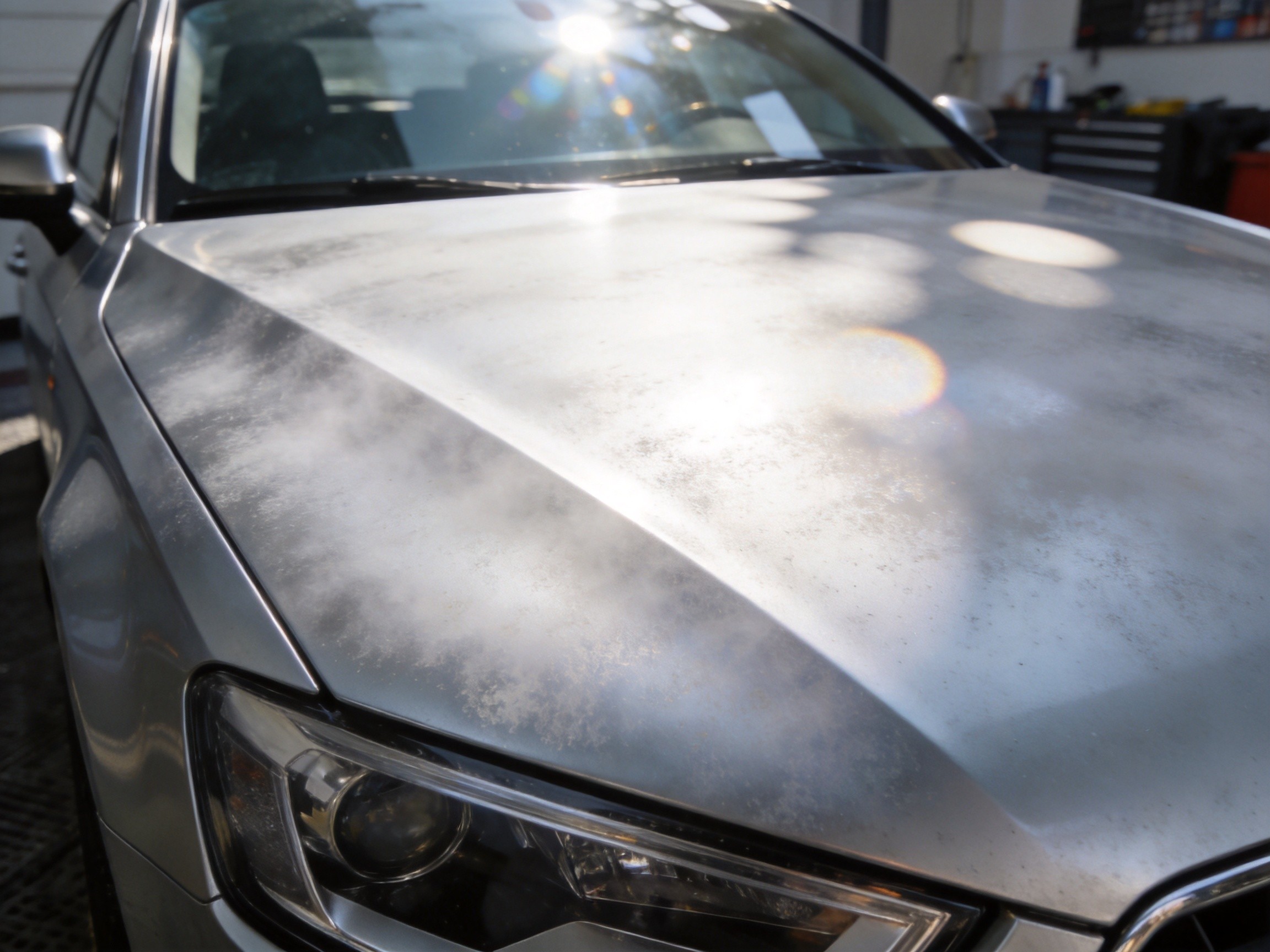
How to Treat Car Paint Oxidation? A Complete Guide to Causes, Diagnosis, and Solutions
Many car owners notice that after two or three years, their paint becomes progressively duller, losing the showroom shine. At the car wash, the technician says “your paint is oxidized.” But what exactly is oxidation? Can you treat it yourself? How much will it cost? This article provides a systematic answer.
1. What Is Paint Oxidation? How Does It Relate to Paint Hazing?
Before discussing oxidation, let’s clarify two concepts: paint oxidation and paint hazing.
Paint oxidation is the cause — a chemical reaction where resin components in the paint react with oxygen in the air, breaking molecular chains and forming carbonyl and hydroxyl groups. This is an irreversible process from the inside out.
Paint hazing is the symptom — the oxidized surface becomes visually hazy with reduced gloss, appearing dull and gray.
Simply put: oxidation is the “disease,” hazing is the “symptom.” They’re often used interchangeably, but strictly speaking, hazing can also be caused by improper application, coating quality issues, or cleaning residue. This article focuses on oxidation-induced hazing.
1.1 Basic Paint Structure
Modern automotive paint typically consists of four layers:
E-coat layer (15-20μm): The innermost protection on the steel body, primarily for rust prevention. Applied at the factory, invisible to the naked eye.
Primer layer (20-30μm): Above the e-coat, enhances adhesion of the base coat and provides additional impact resistance.
Base coat (15-20μm): The color-determining layer — white on a white car, black on a black car.
Clear coat (30-50μm): The outermost transparent protective layer that shields the base coat from UV and pollutants while providing gloss and mirror-like finish. Polishing primarily works on this layer.
Total OEM paint thickness is approximately 80-130μm. Understanding this structure helps you understand why polishing should be done sparingly.
1.2 The Essence of Oxidation: Chemical Reaction in the Clear Coat
Paint oxidation primarily occurs in the clear coat. Clear coats are mainly composed of acrylic polyurethane, containing unsaturated bonds in the resin molecules — these are oxidation’s “weak points.”
Oxygen molecules react with these unsaturated bonds, causing molecular chain breakage. This occurs slowly at normal temperatures, but the reaction rate doubles for every 10°C increase.
The end products are carbonyl compounds, which appear yellow or brown. The visible result is whitening, loss of gloss, and a transition from mirror-like to matte texture.
According to the International Automotive Detailing Association (IADA), UV radiation accounts for over 65% of paint degradation — the primary driver of paint oxidation.
2. Causes of Paint Oxidation: What’s Destroying Your Paint?
2.1 Objective Factors: Inevitable Environmental Oxidation
UV radiation: UV light (280-400nm) carries enough energy to break resin chemical bonds. Vehicles parked outdoors continuously age 4-6 times faster than garage-stored vehicles.
Acid rain: Urban acid rain typically has a pH of 4.2-4.8. Acidic substances react with amino and hydroxyl groups in the paint, creating microscopic etch points that cause diffuse reflection and reduce gloss.
Industrial pollution: Sulfides and nitrogen oxides in the air react with paint surfaces, accelerating oxidation. Industrial cities show significantly faster oxidation rates.
Bird droppings and tree sap: Bird droppings can reach pH 3.5-4.0, extremely corrosive. Tree sap and insect residues are similarly acidic. If not cleaned promptly, these create “acid etch zones” — hotspots for localized oxidation.
2.2 Subjective Factors: Avoidable Accelerated Oxidation
Improper parking: Under trees (bird droppings, sap), near factories (industrial pollution), near construction sites (dust and acidic substances).
Wrong washing methods: Using dish soap increases gloss loss rate by 41% compared to professional car wash products. Dish soap has high pH and leaves surfactant residue.
Wrong wiping tools: Using cotton towels creates 3.2 times more micro-scratches than microfiber towels. Micro-scratches破坏 the mirror structure and accelerate oxidation.
Improper polishing technique: When polisher speed exceeds 3000 RPM, local paint temperature can exceed 80°C, causing thermal decomposition of polish into a hazy residue. Also, doing only compounding without finishing leaves micro-scratches filled with wax — once the wax wears off, the haze reappears.
2.3 Oxidation Speed and Vehicle Color
Dark-colored paint (black, dark blue) shows hazing significantly more than light-colored vehicles. Dark paint is more sensitive to light scatter — the same micro-scratches are far more visible on dark surfaces.
According to IADA data: Among vehicles over 3 years old, 68% exhibit some degree of paint hazing. Dark vehicles: 82% hazing rate; light vehicles: 45%.
White cars have a special issue: yellow spots, typically from iron particle oxidation, resin adhesion, or prolonged UV exposure.
3. How to Assess Oxidation Severity
3.1 Professional Gloss Level Classification
Professional assessment uses a gloss meter measuring at 20° angle:
| Haze Level | Gloss Range (GU) | Surface Characteristics | Recommended Solution |
|---|---|---|---|
| Light | 70-85GU | Slight haze visible under strong light, smooth feel | Clean + wax/sealant |
| Moderate | 50-70GU | Noticeable dullness, rough feel | 3-stage polish + coating |
| Severe | <50GU | Severe gloss loss, visible micro-cracks | Repaint or partial respray |
New paint typically rates 90+ GU (some premium vehicles exceed 100 GU). Below 70 GU, most people can visibly notice “the car isn’t shiny anymore.”
3.2 Practical On-Site Quick Assessment
Method 1: Back-of-hand test Run the back of your hand across the paint. High resistance and roughness = oxidized. Smooth with low resistance = still in decent condition.
Method 2: J1 Cleaning Wax test Wipe a 10×10cm area 5 times with J1 All-in-One Cleaning Wax, then observe:
- Gloss improvement >30%: Light oxidation
- Gloss improvement 10-30%: Moderate oxidation
- Gloss improvement <10%: Severe oxidation
3.3 Typical Manifestations by Severity
Light oxidation: Slight gloss reduction, mild haze under sunlight, smooth feel, typically 1-2 year-old vehicles.
Moderate oxidation: Noticeable whitening, foggy appearance in sunlight, rough feel, brief improvement after washing that quickly returns, typically 3-5 year-old vehicles.
Severe oxidation: Severe gloss loss, matte appearance, possible micro-cracking or chalking, noticeable roughness, possibly exposed base coat, typically 5+ year-old vehicles parked outdoors.
4. Treatment Solutions by Severity Level
4.1 Light Oxidation: Cleaning-Focused, Avoid Excessive Cutting
Step 1: Deep cleaning Use J1 All-in-One Cleaning Wax for full-vehicle cleaning. Its cleaning system combines surfactants, micro-abrasive particles (only 8%), and solvents to effectively remove contaminants without significant cutting.
Step 2: Gentle brightening Use a professional maintenance wax with微量 polishing agents, paired with a DA polisher and foam pad. Key parameters: 1500-1800rpm, pressure under 2kg, cross-hatch pattern.
Step 3: Mirror finishing Use J5 Mirror Finish Agent with a finishing foam pad at 1200-1500rpm. J5’s dust-free formula has a significant advantage — traditional finishing waxes generate dust that interferes with effect assessment.
After J5 treatment, 20° gloss typically recovers to 90+ GU.
Step 4: Long-term protection
- Wax: Every 2-3 months, 3-6 month duration
- Sealant: Every 6 months, 6-12 month duration
- Coating: Annual, strong weather resistance
- Ceramic coating: Every 2 years, highest hardness and protection
4.2 Moderate Oxidation: Compound-Finish-Protect Three-Step Process
Step 1: J2 compounding Use J2 Water-Based Polish with a wool pad. RO at 1800-2200rpm; DA at 1500rpm. J2’s rounded aluminum oxide particles (3-5μm) remove ~2-3μm per pass.
Key rule: No more than 2 minutes per 60×60cm area. Beyond that, cutting force converts to heat, risking paint burn-through.
Step 2: J5 fine finishing After compounding, surface roughness is Ra 0.2-0.3μm (source of haze). J5’s 0.5-1μm particles reduce this to below Ra 0.05μm. Use soft foam pad, 1200rpm, light pressure, two cross-hatch passes.
Step 3: Ceramic coating protection Premium SiO2 ceramic coating reaches 9H hardness, hydrophobic angle >110°, lasting 18-24 months. Pre-coating degreasing must be thorough.
4.3 Severe Oxidation: Reassess Cost-Effectiveness
First: Measure clear coat thickness. If >20μm, consider polishing. If <20μm, recommend repainting.
| Option | Cost | Duration | Suitable For |
|---|---|---|---|
| Full heavy polish + ceramic | $300-450 | 6-12 months | High-value cars with adequate clear |
| Partial repaint | $50-75/panel | Permanent | Localized severe fading |
| Full repaint | Domestic $450-750, imported $1200-2200 | Permanent | High-resale vehicles |
4.4 Special Case: Application-Induced Hazing
Characteristics: Hazing appears 1-2 weeks after polishing or coating. Looks great initially, then foggy.
Causes: Only compounded without finishing; speed too high burning the wax; incomplete degreasing leaving false gloss.
Treatment: Full degreasing → light polish to remove haze layer → proper finishing → re-protect.
5. DIY Polishing for Paint Oxidation
5.1 When Is DIY Appropriate?
- Light swirl marks and hair scratches
- Oxidation-induced dullness
- Routine maintenance
5.2 DIY Product Combinations
Plan A: Light maintenance — J1 + foam pad, hand application
Plan B: Moderate repair — J5 + fine foam pad, 600-800rpm
Plan C: Deep repair — J2 + wool pad (compound) → J5 + fine foam pad (finish)
5.3 Common DIY Mistakes
Mistake 1: Higher speed is better. Speed too high damages paint. J2 at 1500-1800rpm, J5 at 600-800rpm.
Mistake 2: Press harder for better results. Light pressure is sufficient. Excessive pressure causes heat buildup.
Mistake 3: One pad for everything. Different stages require different pads.
Mistake 4: No protection after polishing. Unprotected paint oxidizes rapidly. Apply wax or coating.
6. Prevention Is Better Than Cure
6.1 Parking
Garage parking is the single most effective measure. It reduces nearly all aging factors.
6.2 Washing Routine
- Summer: weekly; Winter: bi-weekly; After rain: always
- Use pH 7-8 neutral car wash soap
- Use 300+ gsm microfiber towels
- Dry with blotting method, not rubbing
6.3 Maintenance Schedule
| Maintenance | Frequency | Expected Result |
|---|---|---|
| Wax | Every 2-3 months | Short-term gloss, basic protection |
| Sealant | Every 6 months | Mid-term protection |
| Coating | Annual | Long-term protection |
| Ceramic | Every 2 years | Ultra long-term, high hardness |
6.4 Contaminant Emergency Treatment
- Bird droppings/sap: Remove within 24 hours
- Iron spots (common on white cars): Use neutral iron remover
- Tar/asphalt: Use dedicated tar remover
7. FAQ
Q: Does polishing damage paint? A: Yes, each polish removes 1-2μm. OEM clear coat is 30-50μm, theoretically handling 5-8 light polishes. Polish sparingly.
Q: Can I treat oxidation myself? A: Light oxidation: DIY with J1 or J5. Moderate: seek professional help (needs RO + J2). Severe: consider repainting.
Q: When can I wash after polishing? A: Immediately. But after ceramic coating, wait 24-48 hours for full curing.
Q: Can ceramic coating completely prevent oxidation? A: No. It’s one of the best protection methods but still ages. Premium SiO2 coatings last 18-24 months.
8. Summary: The Logic of Paint Oxidation Treatment
- Assess severity: Determines the treatment approach
- Light oxidation: Clean + wax, avoid excessive cutting, J1 + J5 is sufficient
- Moderate oxidation: J2 compound + J5 finish + ceramic protection — all three steps are essential
- Severe oxidation: Measure clear coat first; polish only if sufficient thickness remains
- Prevention first: Garage parking, regular cleaning, scientific maintenance is far more cost-effective
Final reminder: Polishing is a double-edged sword — each pass removes a layer of your clear coat. Don’t polish unless necessary. Good daily maintenance can keep your car’s gloss above 80 GU even after 8 years — that’s the truly cost-effective approach.