
Introduction: DIY Polishing Feasibility Assessment
You can absolutely polish your car yourself. With the right products, basic technique mastery, and speed control, DIY owners can achieve basic paint restoration and care at home.
This doesn’t mean challenging a full-car heavy restoration right away — rather: daily care, light swirl mark removal, oxidation treatment — these are things you can handle.
This article builds your complete DIY polishing knowledge across three dimensions: tool selection, product pairing, and application steps.
1. Are You Suitable for DIY Polishing? Paint Assessment First
1.1 What’s Completely Suitable for DIY
Light swirl marks and hair scratches: Visible as dense tiny spiral patterns at an angle in sunlight. These are shallow, only affecting the clear coat surface. DIY can handle them.
Oxidation-induced dullness: After 2-3 years, paint loses its new-car brightness, as if covered with haze. Moderate oxidation can be restored with polishing.
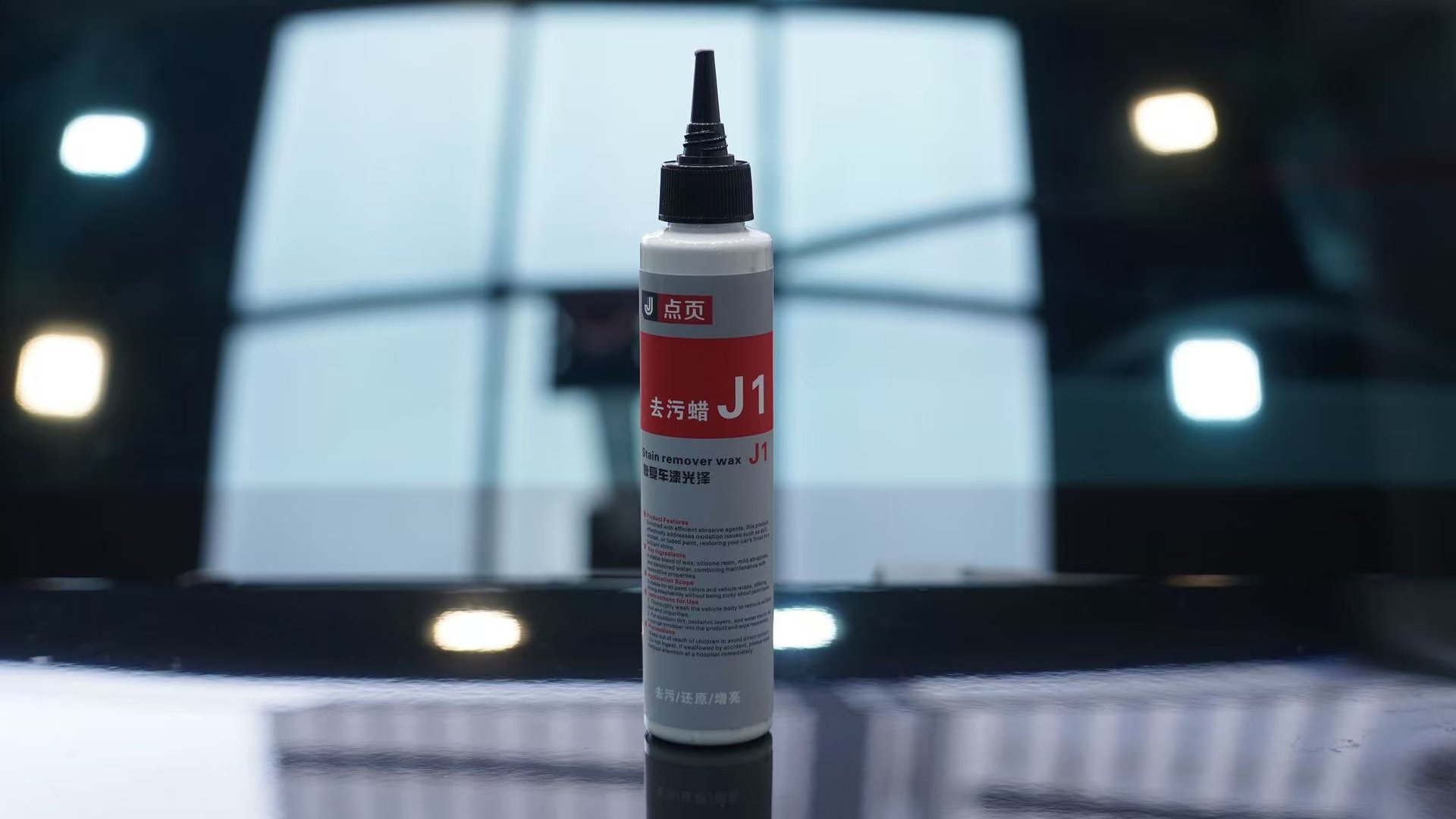
Daily care needs: Post-wash shine maintenance. J1 All-in-One Cleaning Wax by hand can handle the entire car in 10 minutes.
New car transport scratches: Fine scratches from transport dust and improper washing during delivery. Best addressed early — low cost, great results.
1.2 When to Seek Professional Help
Deep scratches catch your fingernail: If your nail catches, the scratch reaches the base coat. DIY can’t achieve invisible repair.
Chalky/degraded paint: If 2000-grit sanding produces white powder, the paint has degraded. Requires deoxidation treatment beyond DIY equipment.
Post-bodywork repaint: New paint may differ in hardness from OEM. Requires more experience to avoid burning through.
2. What Tools Do You Need?
2.1 Core Tool: Polisher Selection
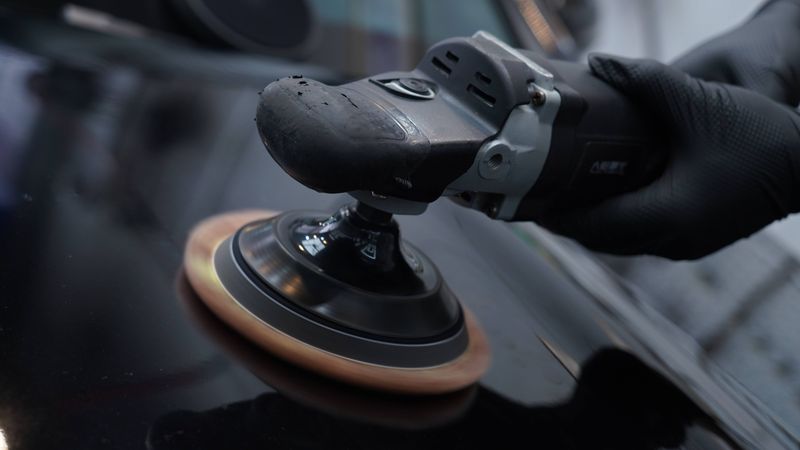
Strongly recommend DA polisher for beginners. DA (Dual Action) produces a complex hypotrochoid trajectory — random motion that prevents sustained friction on any single point.
Why beginners must choose DA:
- High forgiveness: Random trajectory, swirl rate only 15-20% of RO
- Good heat management: Random paths allow heat dissipation
- Wide operating window: 1-3kg recommended pressure, easy to manage
DA polisher specifications:
| Parameter | Beginner | Advanced |
|---|---|---|
| Orbit throw | 12-15mm | 15-21mm |
| Power | 300-500W | 500W+ |
| Speed range | 4000-7500 OPM | 4000-8000 OPM |
| Pad attachment | Hook-and-loop | Hook-and-loop |
15mm orbit is the most validated beginner specification, with 70%+ success rate.
2.2 Pad Selection
Long wool pad (coarse): High cutting, for J2 first-pass compounding. Beginners should start with hard foam — wool is too aggressive.
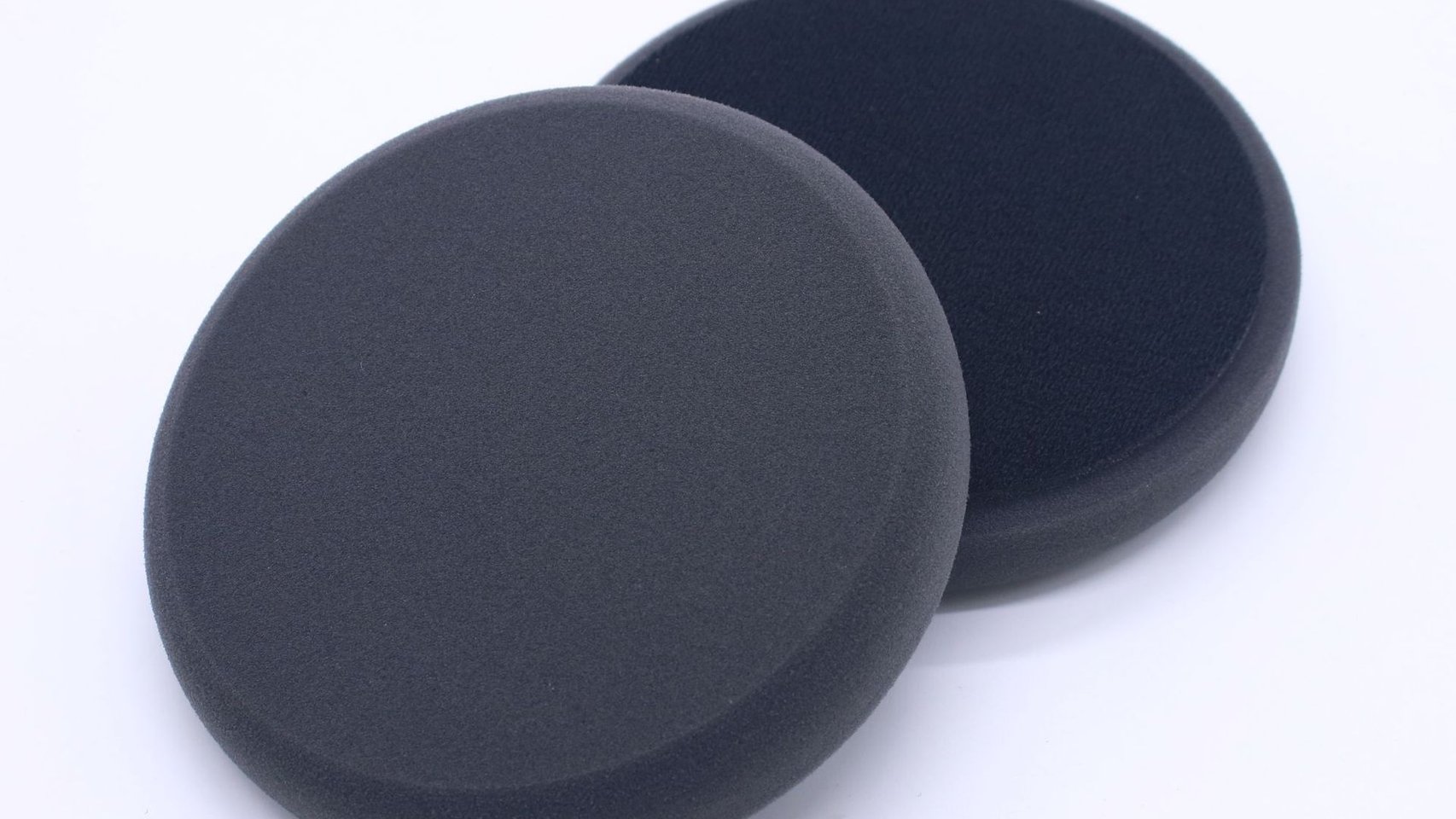
Fine foam pad (soft): Minimal cutting. Must use with J5 Mirror Finish Agent for eliminating compounding holograms.
Microfiber pad: For final brightening with glaze products.
2.3 Auxiliary Tools
- Masking tape: Protect plastic, rubber, lights
- Microfiber towels: At least 3 — one for application, one for inspection, one for final buff
- Work light: 5000-6000K color temperature for paint inspection
- Wash supplies: Neutral soap, clay bar, degreaser
3. Product Selection: Three Plans for All Scenarios
3.1 Light Care: J1 All-in-One Cleaning Wax
For good-condition paint needing a brightness boost, or post-J2/J5 maintenance. Hand application only, no machine needed. Cleans, shines, and protects in one step. Can rinse immediately after application.
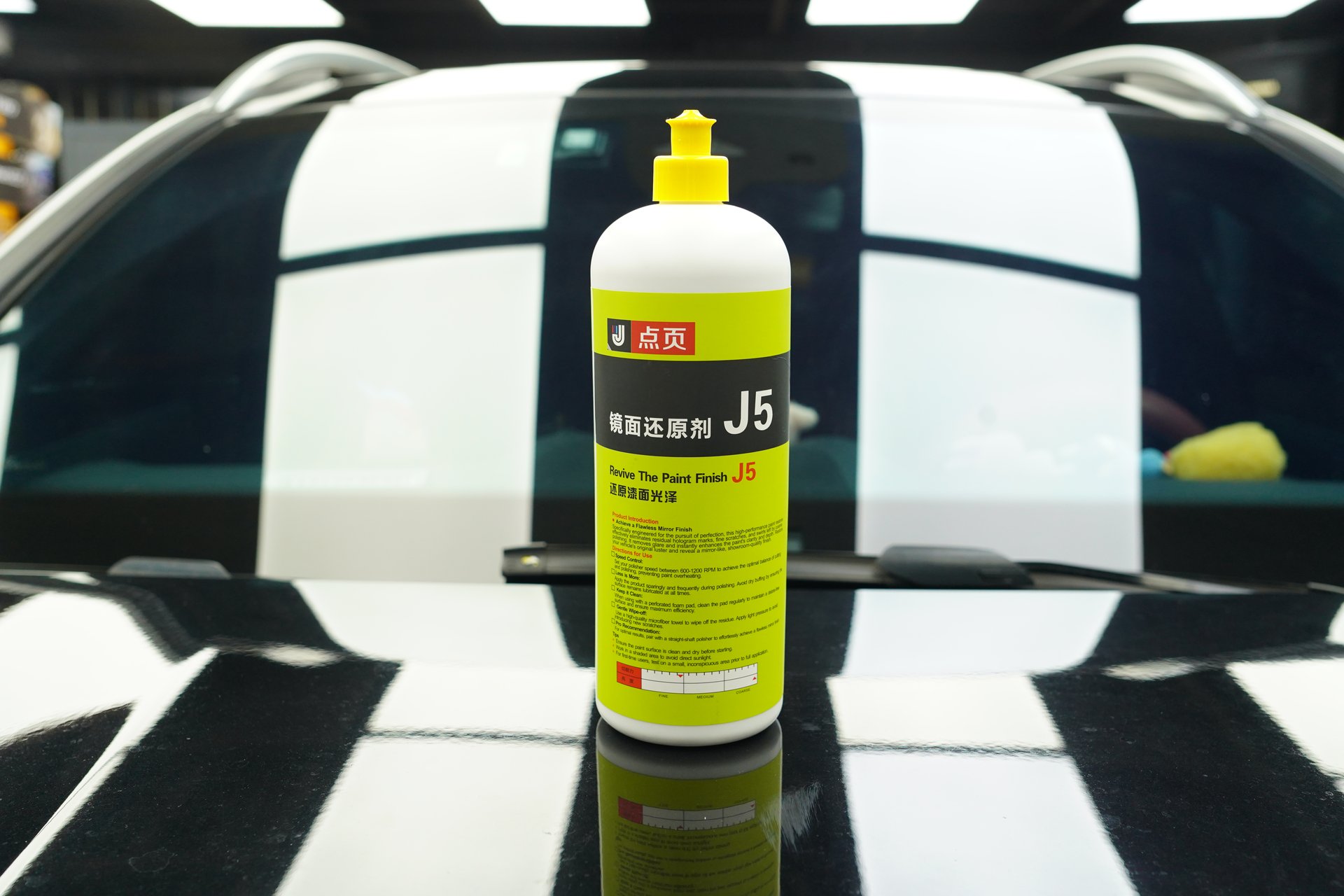
3.2 Medium Repair: J5 Mirror Finish Agent
For light swirl marks, mild oxidation, or post-J2 compounding finish. 600-800rpm, 0.5-2kg pressure, 50×50cm max area. Specifically effective on dark paint swirl marks.
3.3 Heavy Restoration: J2 + J5 Combination
For heavy oxidation, dense scratches, pre-sale preparation, or old car restoration. J2’s water-based formula offers three advantages: no sanding residue, eco-friendly/low odor, and moderate cutting power.
J2 parameters: 1500-1800rpm (beginners: 1200-1500rpm), 1-3kg pressure, ≤50×50cm per area, ≤30 seconds per spot. Must follow with J5.
4. Standard Application Process
4.1 Pre-Application Preparation
- Wash with clay bar and neutral soap
- Assess paint under good lighting
- Mask plastic, rubber, emblems, lights
4.2 Section-by-Section Principle
Divide the car into 50×50cm sections. Process hood first (large, visible), then doors, then roof and trunk. Check results every 2-3 sections.
4.3 J2 Compounding Standard Process
- Install wool pad, align center
- Apply J2 to pad (3-5 dots), avoid edges
- Pre-spread at low speed before powering on
- Polish at 1200-1500rpm, 1-2cm/s movement, 1/3 overlap
- Wipe and inspect. If scratches remain, 1-2 more passes. If 3 passes ineffective, upgrade approach.
Temperature monitoring: Stop if too hot to touch. 60°C is the safety limit.
4.4 J5 Finishing Standard Process
- Switch to foam finishing pad
- Apply J5 (3-5 drops, less than J2)
- 600-800rpm, half the speed of J2
- Paint should show transparent high-gloss after J5
4.5 Post-Application
- Clean all residue with microfiber
- Inspect from multiple angles under good lighting
- Apply protection within 48 hours: paste wax, sealant, or ceramic coating
5. Five Common Pitfalls
Pitfall 1: Higher speed = better. Wrong. Above 2500-3000rpm, a liquid lubrication film forms, reducing actual contact.
Pitfall 2: Press harder for better results. Wrong. Light pressure, let the pad and product do the work.
Pitfall 3: One pad for everything. Wrong. Different stages require different pads.
Pitfall 4: No protection after polishing. Wrong. Polished paint is “naked” and oxidizes faster.
Pitfall 5: Unlimited polishing. Wrong. Each polish removes ~3-5 microns. Max 2 full-car polishes per year.
6. Quick FAQ
Q: Can I polish a new car? A: New car paint is generally good. For light transport scratches, use J5 + finishing pad on affected areas only.
Q: Can J1 fully replace J2+J5? A: No. J1 is for daily care on good-condition paint. For visible scratches or significant oxidation, you need J2+J5.
7. Product Recommendations
Entry (daily care): J1, hand application, 10-15 minutes for full car
Advanced (light repair): J5 + DA (15mm) + foam pad, 2-3 hours
Deep (heavy restoration): J2 + wool pad → J5 + foam pad, 4-6 hours
Conclusion
DIY polishing doesn’t require you to become a professional overnight. Start with J1 to build familiarity, use J5 on one swirl-marked area to feel the machine-paint interaction, then progressively challenge more complex tasks.
DianYe’s product line (J1/J2/J5/X1) was designed with a beginner-to-advanced growth path in mind.
Remember: You can absolutely polish your car yourself. Choose the right tools, use the right products, follow the process, and you can restore your car’s mirror-like gloss.