
Introduction: Why This Article Matters
The choice of polishing materials directly determines application results and paint safety. Many car owners are confused by “polish” and “compound,” thinking they’re similar. In reality, these product categories differ fundamentally in composition, purpose, and operating difficulty. Choosing wrong ranges from poor results to paint damage.
1. Core Difference: Explained in One Sentence
Polish uses wax as the base carrier, mixed with 5-20% abrasive particles. It integrates cutting, filling, and protection in one product — simple to use, high forgiveness, suitable for daily care and general scratch treatment.
Compound uses oil or solvent as the base, with abrasive concentration reaching 30-60%. It’s designed for high-efficiency cutting, requires professional technique, suitable for deep scratches and special requirements.
The core difference is abrasive concentration. This value directly determines cutting power, application difficulty, and suitable scenarios.
2. Polish Deep Dive: The Daily Care Choice
2.1 What Is Polish?
Essentially a mixture of “wax + abrasive particles + functional additives.” The wax carrier (carnauba, beeswax, synthetic wax) provides lubrication and film formation; abrasives handle cutting; additives provide brightening, filling, etc.
2.2 Polish Classification
By physical state: Solid wax (traditional, harder, for machine application), paste wax (soft, easy to apply, most common form), liquid wax (good flow, for polisher or final brightening).
By cutting power: Light polish (~5-10μm particle size, for hair scratches), medium polish (~10-15μm, for swirl marks), heavy polish (~15-20μm, for visible scratches).
2.3 Typical Product: J2 Water-Based Polish
J2 is DianYe’s water-based medium polish — a representative product.
Why choose J2?
- Water-based, no sanding residue: Traditional oil-based polishes leave white powder after buffing. J2’s water-based formula wraps abrasives in wax, producing less dust.
- Moderate cutting: ~15μm particle design, effective for swirl marks and oxidation without excessive paint removal.
- High forgiveness: Even beginners lingering too long won’t easily cause severe holograms.
- Eco-friendly, low odor: No harsh solvent smell.
J2 suitable scenarios: Moderate oxidation, swirl marks, light scratches (no nail catch), new car decontamination.
3. Compound Deep Dive: The Professional Restoration Tool
3.1 What Is Compound?
“High-concentration abrasives + oil/solvent carrier” precision grinding material. Abrasive concentration 30-60%, 3-6x that of polish.
Two characteristics: extremely strong cutting and extremely low forgiveness.
3.2 Compound Classification
By abrasive type: Aluminum oxide (most common, versatile), silicon carbide (harder, faster cutting), chromium oxide (fine grinding), diamond (top hardness, precision instruments).
By particle size: Coarse (40-80μm, deep scratches/burr/old coatings), medium (10-40μm, surface smoothing), fine (1-10μm, final fine treatment).
3.3 Operating Requirements
- Equipment: Must use professional polisher. Hand application insufficient.
- Parameters: Typically 2000-3000rpm, stable pressure, uniform speed, strict time control per spot.
3.4 Why Beginners Shouldn’t Use Compound
Risk 1: Paint damage — 3-6x cutting power of polish. Beginners can easily burn through clear coat. Risk 2: Deeper scratches — Coarser abrasives can create deeper marks if not following coarse-to-fine sequence. Risk 3: Operational issues — Usually requires RO machine, which produces obvious holograms and rapid heat buildup when misused.
4. Detailed Comparison
| Comparison | Polish | Compound |
|---|---|---|
| Abrasive concentration | 5-20% | 30-60% |
| Cutting power | Medium | Extremely strong |
| Operating difficulty | Low | High |
| Forgiveness | High | Extremely low |
| Suitable users | Car owners, DIY enthusiasts | Professional technicians |
| Equipment needed | DA sufficient | Usually requires RO |
4.2 Scenario Comparison
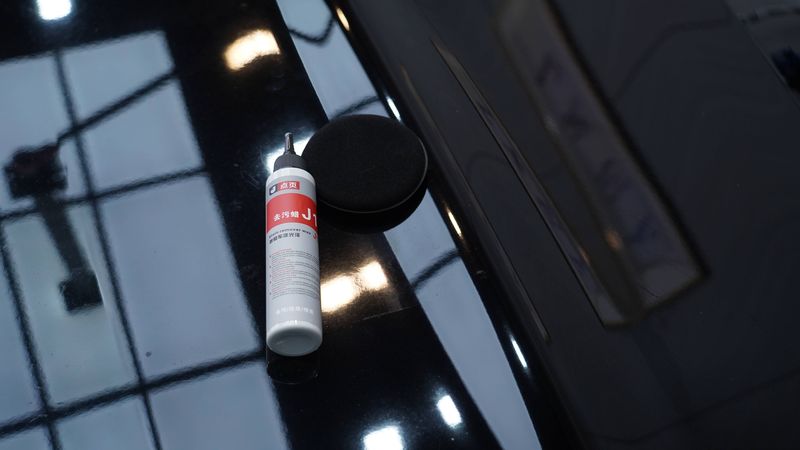
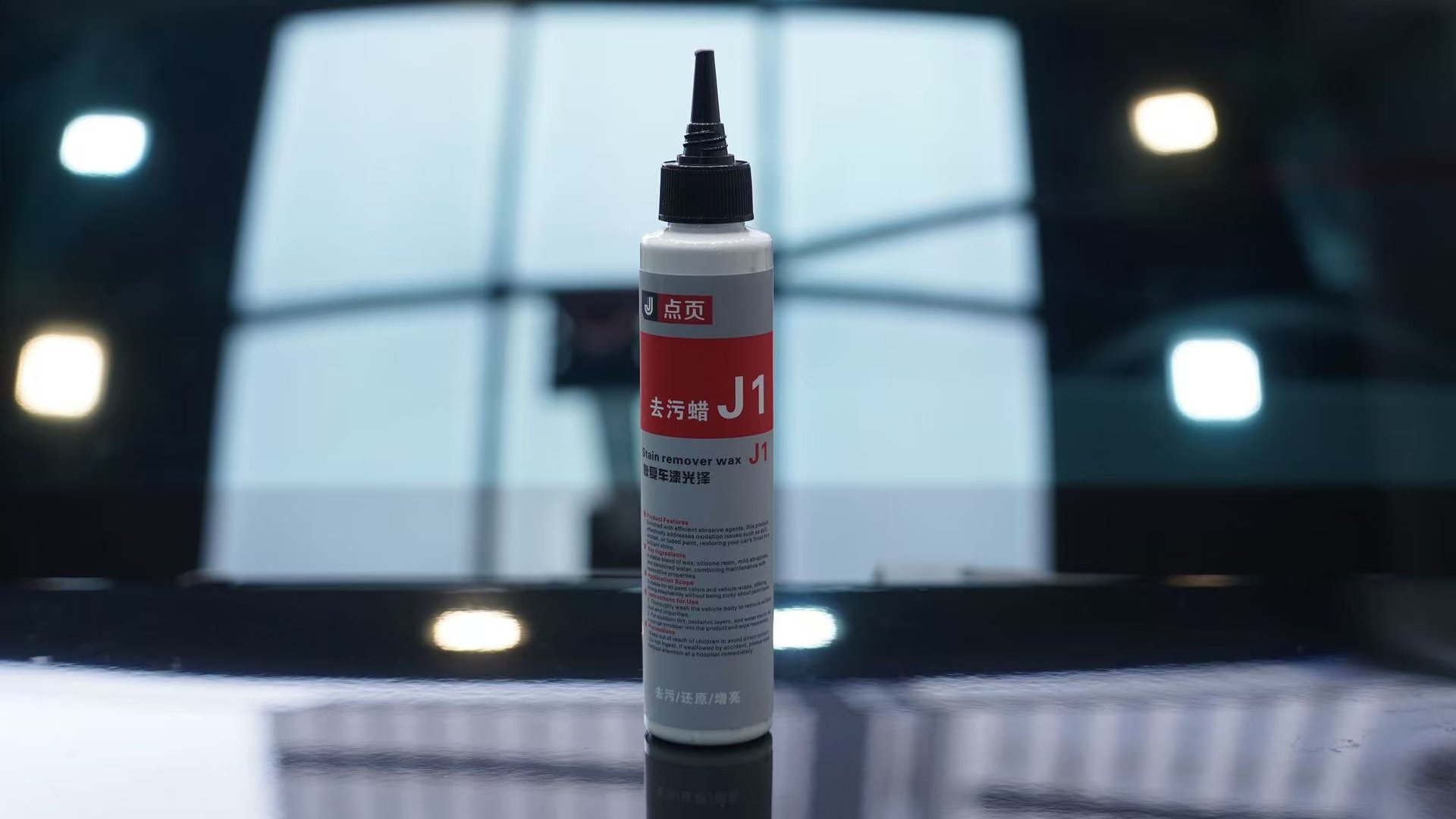
- Daily care: Polish. J1 for quick clean/shine/protect.
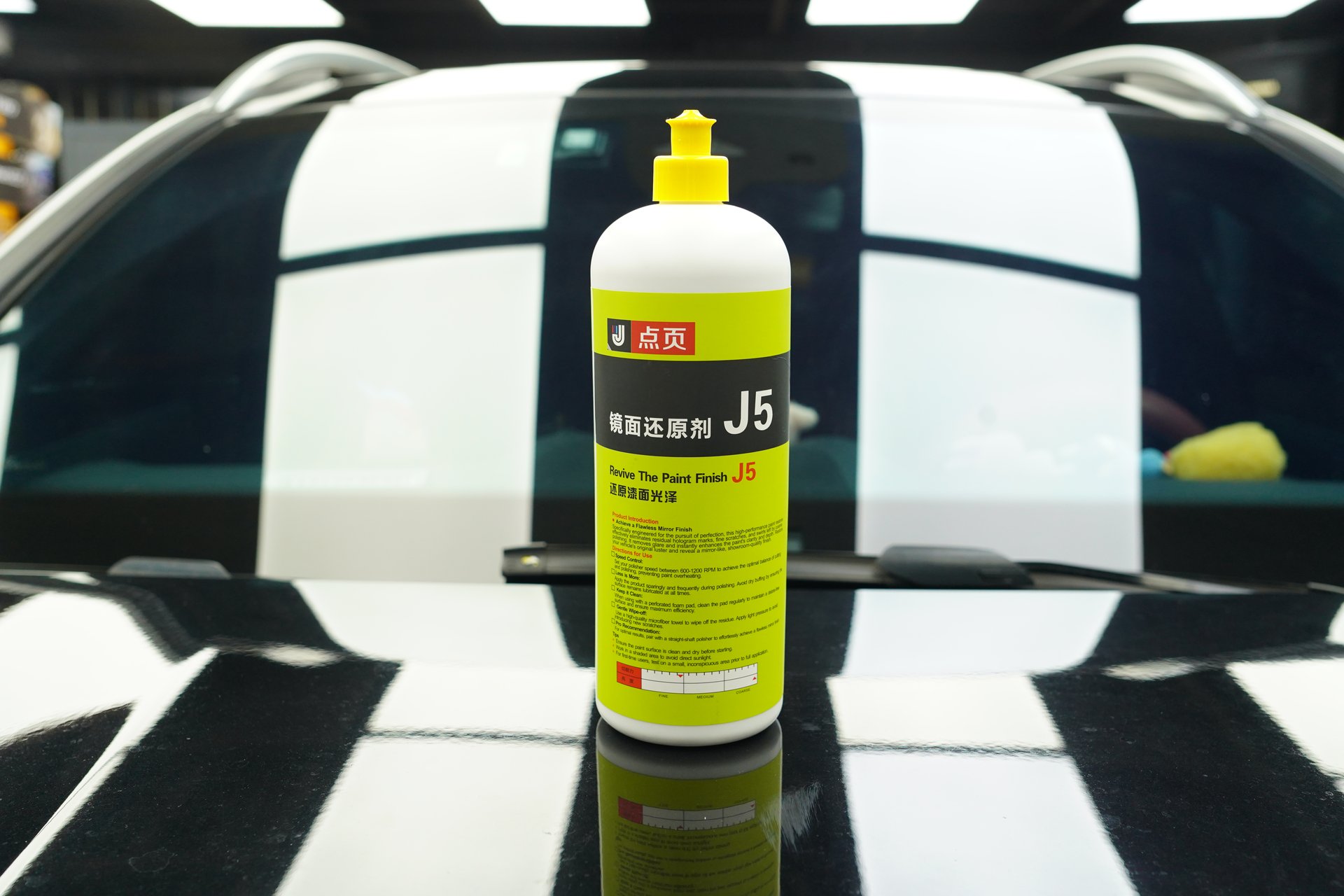
- Light scratches: Polish. J5 for swirl marks.
- Medium scratches: Polish. J2 handles most.
- Heavy restoration: Only scenario potentially needing compound. But even then, follow “polish first, compound only if needed.”
4.3 Why J2+J5 Handles 99% of Daily Needs
J2 handles the problem: Medium scratches, oxidation, swirl marks — cutting just enough. J5 solves J2’s marks: Finer particles eliminate J2’s micro-holograms, achieving mirror finish.
5. Quick Selection Guide
| Paint Condition | Recommended | Difficulty |
|---|---|---|
| Slightly dull, gloss loss | J1 All-in-One | Simple |
| Swirl marks, light scratches | J5 Mirror Finish | Medium |
| Moderate oxidation, visible scratches | J2 Water-Based Polish | Medium |
| Severe oxidation, deep scratches | J2+J5 combination | Complex |
| Sand marks, heavy restoration | Professional shop | Complex |
| Experience Level | Recommended | Notes |
|---|---|---|
| First attempt | J1 All-in-One | Simplest, build confidence |
| A few times | J5 Mirror Finish | Needs DA but forgiving parameters |
| Experienced | J2 Water-Based Polish | Needs parameter control |
| Professional | Full range + compound | Complex scenarios |
Conclusion
For most car owners, polish (J1/J2/J5) is completely sufficient. The J2+J5 combination follows the proven “coarse to fine” logic for most daily scratch and oxidation issues.
Compound is reserved for professional situations — beginners should not attempt it.
Remember: Choosing the right product is half the battle. The rest is proper application technique and appropriate patience.