
What Causes Orange Peel Texture on Car Paint? Understanding Formation Before Polishing Wax Treatment
1. What Exactly Is That “Orange Peel” on Your Paint
Wash your car, walk around it in the sunlight, and you”ll notice the paint isn”t mirror-smooth. Instead, there are wave-like textures across the surface — up close, it looks like the bumpy skin of an orange or pomelo. That”s what the industry calls “orange peel.”
I”ve been in automotive detailing for years, and after talking with countless car owners, I”ve noticed something interesting: most people think orange peel is caused by paint aging or quality issues. It”s not. Virtually every production car”s factory paint has orange peel — including the luxury brands you spent hundreds of thousands on. The difference is just how visible it is.
The technical definition of orange peel: wavy undulations on the paint film surface, with peak-to-valley spacing typically between 0.1 and 30mm, and a height difference of roughly 3μm. That sounds tiny, but the human eye is extremely sensitive to light reflection — those surface waves scatter incoming light in different directions, so you see alternating light and dark patches instead of uniform gloss.
 Typical orange peel: paint surface shows wave-like patterns similar to an orange”s skin
How to Judge How Bad Your Orange Peel Is?
I generally use three methods:
- Fluorescent Light Reflection Test: Stand under a tube light and look at the reflection on your paint. Clear, straight reflection lines = mild orange peel. Distorted, blurry lines = noticeable orange peel. This is the most intuitive method.
- Close Range (within 50cm): You can see fine, short wave patterns (0.3–1.2mm). This is short-wave orange peel.
- Long Range (2–3 meters): You can see明显的 undulating waves (1.2–12mm). This is long-wave orange peel, indicating a more severe case.
One thing to note: orange peel barely affects gloss meter readings. You might get a high number on the gloss meter, but orange peel dramatically reduces “distinctness of image” (DOI) — the clarity of reflected images. So some cars look quite glossy, but the reflections are a blurry mess. That”s orange peel at work.
2. The Root Cause of Orange Peel: Leveling vs. Curing in a Race
Now that we know what orange peel looks like, let”s get to the core question: how does it form?
One sentence summary: Whether the wet film manages to level out before being frozen by curing — it”s a race between leveling and solvent evaporation. Whoever wins first determines whether orange peel forms.
Here”s the detailed process:
Step 1 — The Moment of Spraying. The spray gun delivers paint as droplets onto the body panel. These droplets land and form microscopic peaks and valleys — picture raindrops hitting mud and creating tiny craters.
Step 2 — The Leveling Window. Freshly applied wet film levels itself through surface tension — surface tension pulls paint from peaks into valleys, trying to create a flat surface. Good leveling agents also help by reducing surface tension, making the paint flow more easily.
Step 3 — Curing Freeze. Meanwhile, solvents keep evaporating. The more solvent escapes, the higher the film viscosity becomes, and the worse its flow becomes. Once viscosity hits a critical point, leveling is forced to stop — the film surface is “frozen.”
Step 4 — Orange Peel Sets. If leveling hasn”t finished when curing freezes the film, those remaining peak-and-valley structures become permanent orange peel.
So you can see, any factor that shortens leveling time or accelerates curing will worsen orange peel. Next, I”ll break it down across three dimensions: materials, process, and environment.
3. Material-Related Causes
3.1 Excessively High Paint Viscosity
Paint that”s too thick has high internal friction — the leveling force simply isn”t strong enough. After spraying, you can directly see spray marks on the film, and leveling is terrible.
Common causes: insufficient thinning ratio, mismatched thinner, or paint that has thickened from prolonged storage.
3.2 Insufficient or Incompatible Leveling Agent
Leveling agents reduce surface tension and help the film flatten. If the formula doesn”t have enough, or if a new batch of leveling agent is incompatible with the system, surface tension can”t drop low enough, and the film tends to contract rather than spread.
An experienced technician once told me about a case: after switching to a new batch of paint, orange peel suddenly got worse. All other parameters stayed the same. The investigation eventually traced the problem to the new batch”s leveling agent.
3.3 Thinner Evaporating Too Fast
This is especially common in summer. The thinner evaporates too quickly, the leveling window is too short, and the film loses flow before it has time to level. The result isn”t just orange peel — it can also cause micro-bubbles and whitening.
3.4 Excess Thixotropic Agent
What does a thixotropic agent do? It makes paint thick at rest and thin when stirred. But if too much is added, viscosity rebounds quickly after spraying, terminating leveling prematurely. The result: poor flow, obvious orange peel, but no sagging.
4. Spray Process-Related Causes
Process parameters affect orange peel far more than most car owners realize. Often the paint is fine — it”s the application parameters that weren”t controlled properly.
4.1 Spray Pressure
This is the parameter that causes problems most often.
Too high: excessive atomization — solvent evaporates heavily in the air, paint droplets are half-dry by the time they reach the surface, and they simply can”t flow.
Too low: insufficient atomization — paint particles are too coarse to fuse together properly.
Correct range: conventional suction-feed spray guns at 2.0–2.5 bar, gravity-feed at 1.8–2.2 bar.
4.2 Spray Gun Distance
Too far (over 25cm): solvent evaporates heavily mid-air, paint droplets arrive “semi-dry” at the surface, severe orange peel.
Too close: localized paint buildup, uneven film thickness.
Standard distance: 15–20cm. I”ve seen some beginners, worried about missing spots, hold the gun way too close — the result isn”t better leveling but sagging.
4.3 Gun Speed and Overlap Rate
Inconsistent gun speed → uneven film thickness → stripe-like orange peel.
Insufficient overlap → visible seams between passes; excessive overlap → local over-thickening. Standard overlap rate: 50%–70%.
4.4 Application Viscosity
The standard range for application viscosity is 16–20 seconds (Ford cup at 25°C). Too high means poor flow and insufficient leveling; too low means sagging risk.
5. Environmental Causes
Many people overlook environmental factors. The same paint, the same technician — the result can vary dramatically under different conditions.
| Environmental Factor | Effect on Orange Peel | Control Range |
|---|---|---|
| Temperature too high | Faster solvent evaporation, shorter leveling time | 20–25°C |
| Temperature too low | Paint becomes viscous, flow decreases | Same as above |
| Humidity too low | Solvent evaporates too fast | Relative humidity 40%–70% |
| Humidity too high | Moisture penetrates film, disrupts leveling | Same as above |
| Airflow too strong | Rapidly strips solvent, flash drying | 0.2–0.5 m/s |
Why Does Refinish Paint Usually Have Worse Orange Peel Than Factory Paint?
The answer is right here. Factory paint lines have climate-controlled, automated environments where every parameter is precisely managed. Refinish bays have far worse conditions — temperature and humidity fluctuate, and everything is hand-sprayed. Gun speed, distance, and pressure all depend on the technician”s skill. Parameter stability can”t compare to a robot.
6. Factory Orange Peel vs. Refinish Orange Peel
These two look similar but differ significantly in cause and characteristics.
Factory Orange Peel Characteristics
- Results from automated spraying as a process trade-off — you could theoretically eliminate orange peel entirely, but the cost is extreme, and you”d sacrifice the clear coat”s scratch and chip resistance
- Some brands use specialized processes. For example, BMW has used PPG”s powder clear coat (Enviracryl) since 1998 — solvent-free, relying entirely on high-temperature baking to melt and level powder particles. The leveling window is extremely narrow, so orange peel is inherently more visible than with liquid clear coat
- Orange peel is most visible on black paint — black reflects light most strongly, exposing surface micro-defects
- Larger vehicles with complex curves (like full-size SUVs) are harder to spray and cure evenly, making orange peel harder to control
Refinish Orange Peel Characteristics
- Refinish paints generally have lower leveling properties than factory paints, so orange peel after repair is usually coarser
- Manual spraying is far less consistent than robotic application
- At the boundary between old and new film during spot repairs, gloss and texture differences are more obvious
7. Which Cars Show Orange Peel More Prominently
This is something many car owners ask about. Here”s a summary:
| Brand/Type | Orange Peel Severity | Reason |
|---|---|---|
| BMW | Orange peel complaints far exceed other luxury brands | Powder clear coat technology, solvent-free, narrow leveling window |
| Japanese (Honda, Nissan) | Visible but not severe | Clear coat tends to be thinner (25–35μm), but leveling window is acceptable |
| Large SUVs/MPVs | More noticeable than sedans | Complex curves and large area double the spraying difficulty |
| Black/dark paint | Most visible visually | Dark paint is most sensitive to light reflection |
| Lexus/Mercedes S-Class | Extremely mild | Nano-ceramic clear coat + nine-step process + factory mirror polishing |
| Repainted vehicles | Usually coarser locally | Manual spraying + refinish paint has inferior leveling |
An important premise: every production car has orange peel. No car achieves absolute mirror finish. Pursuing zero orange peel requires extreme coating process investment, and it would weaken the clear coat”s durability. So if you notice orange peel on your car, don”t panic — the question isn”t “is there orange peel,” but “how severe is it, and does it need treatment?“
8. How to Classify Orange Peel Severity
The industry evaluates orange peel using two indicators:
- Long Wave (LW): wavelength 1.2–12mm, undulations visible from a distance at long range. Lower numbers are better.
- Short Wave (SW): wavelength 0.3–1.2mm, fine texture visible at close range. Lower numbers are better.
For visual assessment, there are roughly three tiers:
| Level | Visual Assessment | Characteristics |
|---|---|---|
| Mild | Faint texture visible within 50cm, barely noticeable beyond 1m | Visible under angled light, doesn”t affect appearance under normal lighting |
| Moderate | Clear undulating texture visible within 1m | Noticeably affects paint quality |
| Severe | Dense undulations visible from distance, reflection lines severely distorted | Similar to pomelo skin texture, rough to the touch |
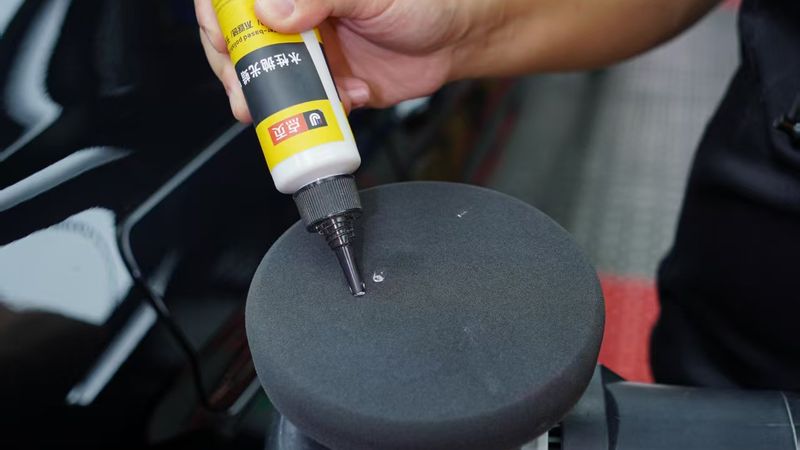
Mild orange peel can be significantly improved through pure polishing with automotive polishing wax — DianYe J3 Medium Polish (3-in-1 polishing compound) paired with a medium foam pad, followed by J5 Mirror Finish Restorer with a fine foam pad for refinement. Two steps and you”ll pull the DOI right back up.
Moderate orange peel requires adding a denim pad leveling step before polishing — use DianYe J2 Water-Based Polishing Compound with a 2000-grit denim pad for initial flattening.
Severe orange peel may require a wet sanding + polishing combination approach. That”s more complex — I”ll cover it in a dedicated article later.
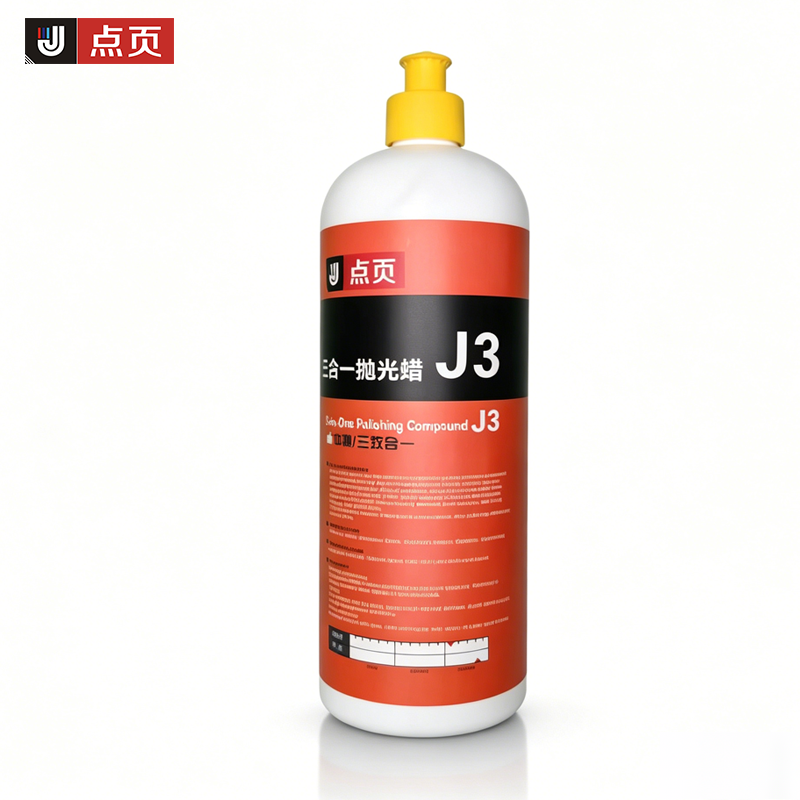 DianYe J3 Medium Polish (3-in-1 polishing compound), the core product for mild orange peel correction
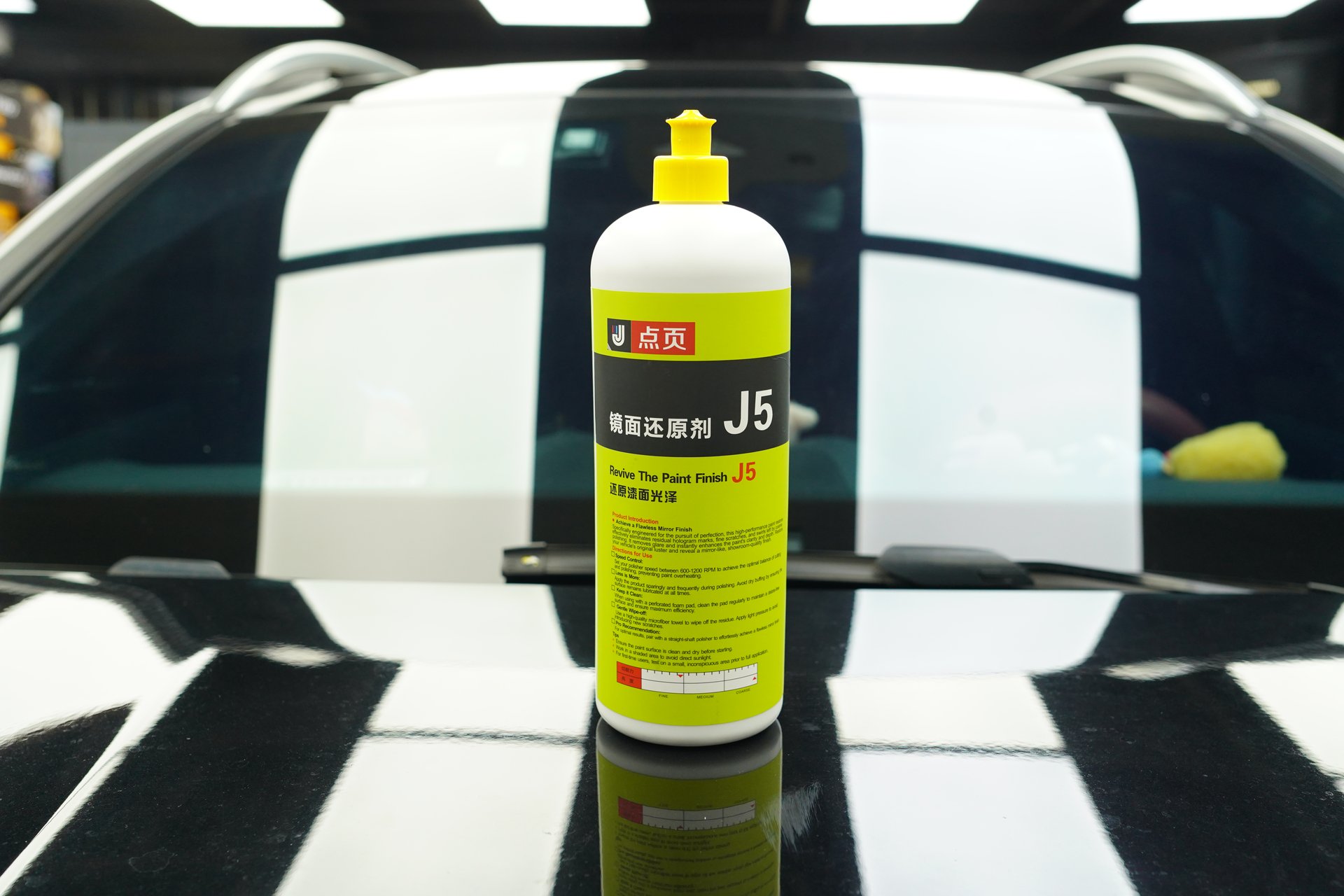 DianYe J5 Mirror Finish Restorer — eliminates polishing marks and restores mirror finish in the refinement stage
9. Summary
The cause of orange peel boils down to “leveling couldn”t outrun curing.” Material formulation, spray parameters, and environmental conditions — any deviation in these three categories can worsen orange peel.
For car owners, here are the key takeaways:
- Orange peel is universal — don”t panic. What matters is the severity level.
- Black cars, large-curve vehicles, and BMWs show orange peel most prominently.
- Mild orange peel can be fixed with automotive polishing wax — no sanding needed.
- The key to treating orange peel is selecting the right products and progressive technique — don”t jump straight to aggressive cutting.
Once you understand how severe your car”s orange peel is and what caused it, you can choose the right treatment approach. In my next article, I”ll cover exactly how to treat different levels of orange peel with specific pad and compound combinations.
DianYe Auto Technology Co., Ltd. specializes in automotive paint care product development. The J series polishing wax covers the full workflow from coarse polishing to medium polishing to mirror finishing. For paint care questions, search DianYe Auto Technology for more professional content.